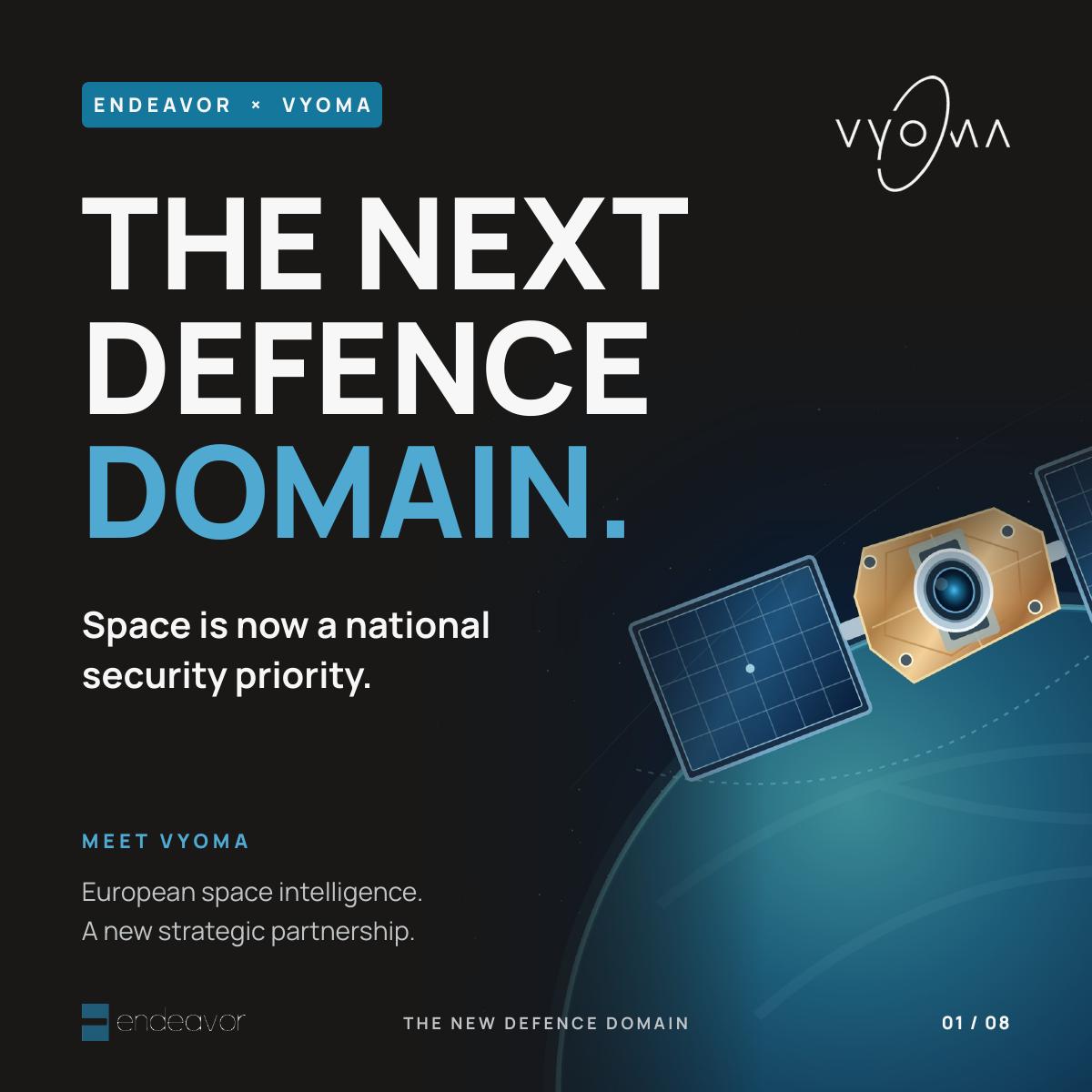
Europe cannot protect what it cannot see. That now includes space.
Endeavor Integrated Solutions is proud to announce its strategic partnership with Vyoma, officially representing the Munich-based space technology company in Greece and Cyprus. The partnership marks an important step in Endeavor’s development across defence, advanced engineering and emerging technologies, bringing a new generation of European space intelligence capabilities closer to the Eastern Mediterranean.
Space is no longer a distant or exclusively scientific domain. It is an essential part of modern infrastructure, economic activity and national security. Satellites support communications, navigation, maritime operations, environmental monitoring, disaster response and the functioning of critical government and defence systems. As reliance on these services grows, so does the importance of understanding and safeguarding the environment in which they operate.
In 2019, NATO recognised space as an operational domain, alongside land, air, maritime and cyberspace. For Europe, the ability to obtain reliable, independent information about activity in orbit is increasingly central to strategic autonomy and resilience. Vyoma addresses precisely this challenge.
Meet Vyoma: a European space intelligence company
Founded in Munich in August 2020 by Dr. Stefan Frey, Dr. Luisa Buinhas and Christoph Bamann, Vyoma combines expertise in aerospace engineering, astrodynamics, software development and satellite operations. Its ambition is to give governments, space agencies and commercial operators greater control over the information they depend on to manage space assets.
Unlike a conventional Earth observation company, Vyoma’s core business is observing the orbital environment itself. Its systems monitor objects in space rather than primarily imaging the Earth’s surface. The resulting information helps operators assess the condition of the space environment, identify potential hazards, and take informed decisions to keep essential satellite services available.
This is the principle behind Space Domain Awareness (SDA): understanding what is happening in orbit and what that activity means for the safety, security and continuity of space-dependent services. Vyoma combines its own observation capabilities with software and data services, creating an integrated offering for civil and governmental users.
Video: Vyoma’s official company presentation. Source: Vyoma.
From observations to actionable information
Space situational awareness is not simply a question of acquiring more images. The value lies in turning measurements into reliable knowledge that operators can use. Vyoma’s approach brings together observations from space and partner ground-based sensors, data processing, orbital analysis and a digital service platform.
Its governmental space intelligence offering spans three levels:
- Surveillance and tracking data: measurements that improve understanding of the objects present in orbit and how the orbital environment is changing.
- Space Domain Awareness software: analysis that helps users interpret orbital events, evaluate risks and build a more complete picture of space activity.
- Independent capability: turnkey combinations of sensing and software infrastructure intended to help customers maintain greater control over their own space-domain information.
For commercial satellite operators, the same engineering foundations support collision-risk management, flight dynamics, mission planning and automated operations. These services can reduce the administrative and engineering burden of managing satellite fleets, allowing operators to devote more resources to their core missions.
For government agencies, a more resilient picture of the orbital environment can support continuity of public services, assessment of hazards and coordination with European partners. The ability to draw on independent information is especially important when national infrastructure depends on satellite availability.

Flamingo-1: from engineering ambition to operational capability
A defining moment in Vyoma’s development came on 11 January 2026, when its first dedicated space surveillance satellite, Flamingo-1, reached orbit. Following successful platform commissioning announced in June, the company confirmed on 29 October 2026 that Flamingo-1 had entered routine operations.
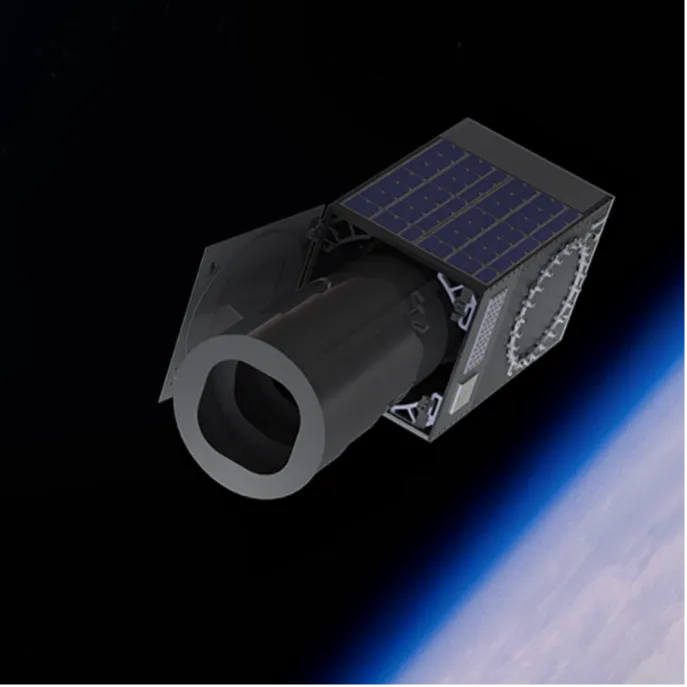
The satellite carries an optical instrument designed for observing other objects in space. By operating above Earth’s atmosphere, it complements terrestrial optical systems, whose observations can be affected by daylight and weather. Data from the satellite is processed by Vyoma and made available through its services platform.
For European customers, Flamingo-1 demonstrates that a dedicated commercial space-based observation service is no longer just a development objective. It is an operational capability from a European company, providing an additional source of information on the orbital environment.
Technical excellence and proprietary innovation
Vyoma’s engineering approach spans the observation instrument, spacecraft operations, software and the processing of orbital information. In June 2025, the company announced that it had secured two German patents relating to its proprietary space-surveillance concept, including innovations in the acquisition and onboard processing of optical observations.
The company uses conventional analytical methods alongside machine-learning techniques to interpret images, distinguish observed objects and improve the quality of the measurements feeding its services. Its long-term objective is to create an independent catalogue of space objects. This is particularly relevant to Europe: an independently maintained data resource offers an alternative to relying exclusively on information supplied from outside the continent.
Vyoma is also developing its next generation of instruments. Flamingo-2 is planned for 2027, with further sensors envisaged for 2028 and 2029. A larger observation network is intended to increase coverage and reduce the time between observations, making the overall service more responsive and resilient. These expansion capabilities remain part of the company’s development roadmap rather than fully deployed services.
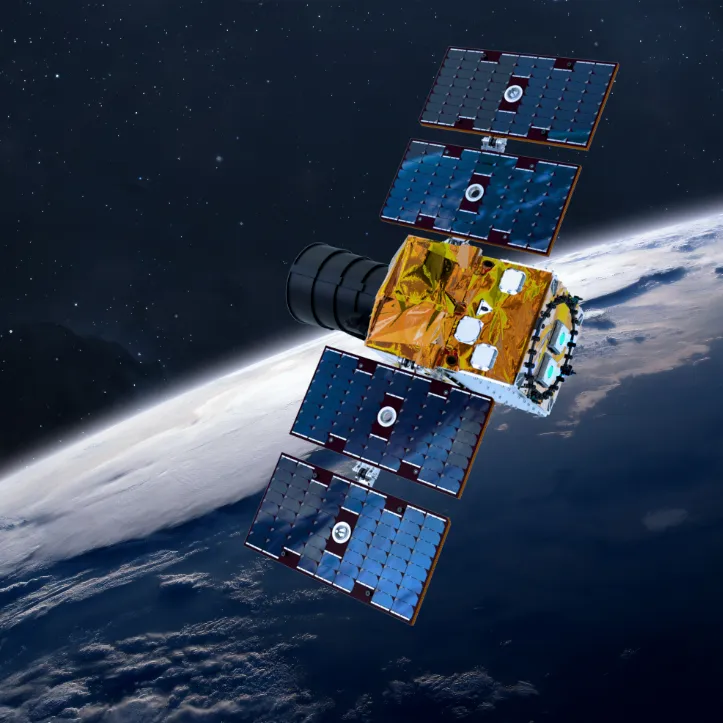
Technology animation: Vyoma. Explore the Flamingo sensor network and technology.
From start-up to European strategic technology company
Vyoma’s development is also a story of European entrepreneurship, research and industrial investment. The founders received early support through Germany’s EXIST start-up grant, ESA’s business incubation ecosystem and business angels. Subsequent investment supported the creation of the company’s initial software services, engineering team and satellite programme.
Its investor base grew to include Atlantic Labs, Faber Ventures, Happiness Capital and Safran Corporate Ventures. In June 2023, Safran announced its participation in an €8.5 million funding round alongside three co-investors. The relationship also opened opportunities for technology collaboration with Safran’s aerospace and defence businesses.
Vyoma subsequently announced a further €5 million investment from an Atlantic Labs-managed space fund backed by the European Investment Fund, bringing its publicly reported total capital raised at the time to more than €16 million in 2024. This is a historical financing milestone, rather than an estimate of the company’s current valuation or cumulative capital.
The company has also progressed from research and investment to commercial activity. In June 2026, Vyoma reported securing institutional customer contracts representing several million euros in annual value following Flamingo-1’s launch. This progress illustrates the increasing demand for space intelligence services and the importance of commercially sustainable European technology providers.

International cooperation and European institutional programmes
Vyoma operates within a growing international industrial network, drawing on specialist capabilities from across Europe and beyond. Its development shows how innovative European companies can combine proprietary engineering with international manufacturing, research and infrastructure partnerships.
- Germany: the German Aerospace Centre (DLR) awarded Vyoma two launch opportunities through its small-satellite competitions in 2023, recognising the company’s contribution to space innovation.
- France: Safran Corporate Ventures’ investment and planned technology collaboration demonstrate the connection between Vyoma’s space intelligence work and an established European aerospace and defence group.
- Bulgaria: EnduroSat was selected to develop satellite platforms for Vyoma’s surveillance programme.
- Belgium: Aerospacelab was contracted in 2024 to deliver the platform and associated integration services for Vyoma’s second satellite.
- Canada and ESA: in April 2026, Vyoma was selected as part of a Kepler Communications-led consortium under ESA’s HydRON Element 3 programme, exploring the delivery of space observation information through future optical communications infrastructure.
Institutional programmes provide further evidence of the relevance of Vyoma’s technology. In June 2024, Vyoma announced two European Defence Fund contracts for EMISSARY and STAALION, with a combined announced value exceeding €2 million. The collaborative projects are intended to strengthen European space security and information independence.
In February 2026, the company was also awarded an ESA data procurement contract under the Space Safety Programme. Observations supplied through this activity are intended to improve scientific understanding of smaller orbital debris and support better risk assessments for space missions.
These partnerships and awards are distinct from customer deployments or government contracts in Greece and Cyprus. They demonstrate the company’s international development and the institutional interest in its technology.
Greece: building a national space ecosystem
The partnership comes at a particularly important moment for Greece, which is moving from being predominantly a user of satellite information towards developing its own space infrastructure, industrial know-how and downstream services.
The country’s National Smallsat Programme, implemented through the Ministry of Digital Governance with support from ESA and the Hellenic Space Center, includes 13 Earth observation microsatellites and 11 experimental CubeSats. Its wider infrastructure includes assembly and testing facilities, optical communications infrastructure and a national space-debris tracking radar.
Greek businesses, universities and research organisations are participating in projects covering optical and radar imagery, thermal observation, maritime monitoring, satellite communications and the development of domestic hardware and software. The Hellenic Space Center identifies international industrial partners including Open Cosmos, ICEYE and OroraTech, alongside Greek industrial and academic teams.
These activities are particularly relevant to a maritime nation. Satellite services can strengthen the understanding of maritime activity, improve environmental monitoring and civil protection, and support reliable connectivity across islands and remote areas. Greek CubeSat initiatives such as MICE-1, DUTHSat-2 and ERMIS illustrate the diversity of research and industrial expertise developing around space applications.
The next phase, HELLAS-SPACE 2.0, is a €350 million national investment programme building on the initial €200 million programme. Its scope includes further Earth observation capabilities, secure connectivity, innovation, space surveillance and in-orbit operations, as well as domestic industrial participation.
As Greece invests in the services that satellites provide, a complementary requirement emerges: ensuring that space infrastructure itself is understood, reliable and resilient. This is where Space Domain Awareness becomes strategically relevant. Vyoma’s solutions offer a potential complement to national programmes and the capabilities of Greek industry, without duplicating their Earth observation or communications missions.
Cyprus: an increasingly connected European space partner
Cyprus is developing its own space ecosystem through research, innovation, satellite communications and European cooperation. Its National Space Strategy 2025–2030 seeks to strengthen domestic expertise, encourage investment and extend the practical use of space technology across society, the economy and public services.
On 17 March 2026, Cyprus became an Associate Member of ESA. This opens access to optional ESA programmes and creates additional opportunities for Cypriot companies, start-ups and research organisations to participate in the wider European space industry.
Cyprus already has a significant connection with satellite infrastructure through Hellas Sat, as well as a growing research community. The ERATOSTHENES Centre of Excellence is developing expertise in Earth observation, remote sensing and related applications. In February 2026, the Centre signed a cooperation agreement with the Hellenic Association of Space Industry, covering research, industrial collaboration and joint opportunities in European programmes.
The connection between Greek and Cypriot space capabilities is already visible in practice. In March 2026, EUSPA announced that Cyprus had completed the first operational use of services through the EU GOVSATCOM Hub, including Greek governmental satellite capacity provided by Hellas Sat.
For Cyprus, secure communications, maritime connectivity, disaster response and reliable access to space-derived information have particular significance in the Eastern Mediterranean. A more mature space ecosystem also creates a growing need for expertise in the protection and dependable operation of space assets.
Why independent space intelligence matters for both countries
Owning or accessing satellite infrastructure is only one component of space sovereignty. The ability to understand the environment in which those assets operate, assess risks independently and maintain continuity of their services is equally important.
For Greece and Cyprus, European space intelligence technology could contribute to the resilience of civil and governmental infrastructure, support the safe operation of emerging satellite fleets and strengthen cooperation with European institutions and industrial partners.
The benefits extend beyond defence. A loss of satellite availability can disrupt shipping and logistics, public communications, disaster monitoring and other critical activities. The civil and security applications therefore share an underlying engineering requirement: dependable information about the space environment.
Developing local knowledge and access to complementary technologies can also help domestic businesses participate more effectively in the European space value chain, including engineering services, data analytics and research collaborations.
Endeavor’s strategic direction: engineering, defence and innovation
For Endeavor Integrated Solutions, the partnership with Vyoma reflects a broader view of how engineering and technology are transforming the maritime and defence sectors.
Our roots in maritime engineering have shaped our understanding of the importance of technical reliability, operational continuity and long-term relationships with technology partners. Those principles are equally relevant to the next generation of advanced systems, whether they operate at sea, on land or in space.
We see the evolution of defence and critical infrastructure as increasingly interconnected with advanced sensing, communications, software, artificial intelligence and reliable access to information. The distinction between traditional industrial engineering and digital innovation is becoming less pronounced. Future capabilities will depend on the ability to bring these disciplines together.
Our strategic approach is to identify European technology companies with strong engineering credentials and relevant solutions, understand the requirements of our markets, and help create productive connections with local industry, institutions and end users.
As Vyoma’s official representative in Greece and Cyprus, Endeavor looks forward to developing these relationships, raising awareness of Space Domain Awareness and exploring opportunities for collaboration. Our aim is to contribute to an ecosystem in which European innovation can translate into meaningful, sustainable capabilities for both countries.
The future of security is increasingly shaped by what happens beyond the Earth’s surface. Endeavor intends to be part of that future.
Learn more about Vyoma at vyoma.space, or contact Endeavor Integrated Solutions to discuss the partnership.
Subsequent development | 17 November 2026
Following the announcement of our partnership, Vyoma reported new agreements with Canada’s Kepler Communications and Poland’s Scanway. These agreements envisage hosting Vyoma’s compact optical payloads on ten Kepler satellites, with deployment planned no earlier than October 2028, and the commercial introduction of an independent object catalogue planned for early 2029.
The collaboration is another example of Vyoma’s international industrial reach and its intention to expand European space intelligence capabilities. The additional sensors and related services are planned developments, not capabilities already deployed.